Simple TCP Server and Client
Just as we start with any programming language, we will implement a simple hello world program in socket programming.
In this article, we will implement a simple TCP server and client.
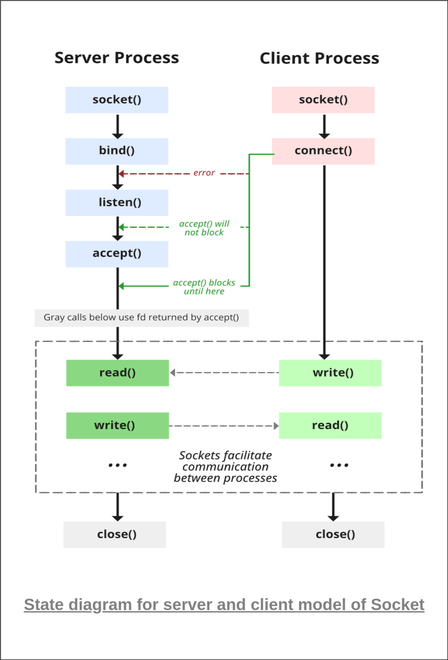
- The server will listen on a specific port and IP address.
- The client will connect to the server and send data to it.
- After receiving the data, the server will send a response back to the client.
- The client will receive the response and print it.
Program Flowchart
image
Source: Socket Programming in C/C++ - GeeksforGeeks
Server Example
#include <stdio.h>
#include <stdlib.h>
#include <string.h>
#include <sys/socket.h>
#include <arpa/inet.h>
#include <errno.h>
#include <unistd.h>

#define IPADDR "127.0.0.1" /* Server IP address */
#define PORT 43866         /* Port number */
#define STRING_LEN_16 16
#define STRING_LEN_64 64
#define BACKLOG 10

char *_inet_ntoa(struct in_addr *addr, char *ipAddr, int len)
{
    // Convert binary IP address to a human-readable IP address
    if (NULL == addr || NULL == ipAddr || 16 > len)
    {
        printf("invalid param\n");
        return NULL;
    }
    unsigned char *tmp = (unsigned char *)addr;
    snprintf(ipAddr, len, "%d.%d.%d.%d", tmp[0], tmp[1], tmp[2], tmp[3]);
    return ipAddr;
}

int main(int argc, char *argv[])
{
    // 1. Create a socket socket()
    int sockfd = socket(AF_INET, SOCK_STREAM, 0); // TCP socket
    if (sockfd == -1)
    {
        printf("fail to call socket, errno[%d, %s]\n", errno, strerror(errno));
        exit(0);
    }

    // Manually build the sockaddr_in structure
    struct sockaddr_in addr;
    memset(&addr, 0, sizeof(addr));    // Initialize the structure to 0
    addr.sin_family = AF_INET;         // IPv4
    addr.sin_port = htons(PORT);       // Port number
    inet_aton(IPADDR, &addr.sin_addr); // Convert human-readable IP address to binary IP address
    // inet_aton is now deprecated because it does not support IPv6

    // 2. Bind the socket to a specific IP address and port bind()
    if (bind(sockfd, (struct sockaddr *)&addr, sizeof(addr)) == -1)
    {
        printf("fail to call bind, errno[%d, %s]\n", errno, strerror(errno));
        close(sockfd);
        exit(0);
    }

    // 3. Put the socket into passive listening state listen()
    if (listen(sockfd, BACKLOG) == -1)
    {
        printf("fail to call listen, errno[%d, %s]\n", errno, strerror(errno));
        close(sockfd);
        exit(0);
    }

    printf("server listen on %s:%u\n", IPADDR, PORT);

    // 4. When the socket is listening, use the accept function to receive client requests accept()
    struct sockaddr_in peerAddr;
    socklen_t peerAddrLen = sizeof(struct sockaddr_in);
    int connfd = accept(sockfd, (struct sockaddr *)&peerAddr, &peerAddrLen);
    if (connfd == -1)
    {
        printf("fail to call accept, errno[%d, %s]\n", errno, strerror(errno));
        close(sockfd);
        exit(0);
    }
    char peerIPAddr[STRING_LEN_16];
    _inet_ntoa(&peerAddr.sin_addr, peerIPAddr, STRING_LEN_16);
    printf("peer client address [%s:%u]\n", peerIPAddr, ntohs(peerAddr.sin_port));

    while (1)
    {
        // 5. Read data sent by the client recv()
        char buf[STRING_LEN_64];
        int n = recv(connfd, buf, STRING_LEN_64 - 1, 0);
        buf[n] = '\0';

        if (0 == n) // n == 0 means the peer closed the connection
        {
            printf("peer close\n");
            break;
        }

        printf("recv msg from client : %s\n", buf);

        sleep(2);

        // 6. Send data to the client send()
        char str[] = "recved!";
        printf("send msg to client : %s\n", str);
        send(connfd, str, strlen(str), 0);
    }

    // 7. Interaction ends, close the socket close()
    close(connfd);
    close(sockfd);

    return 0;
}
Client Example
#include <stdio.h>
#include <stdlib.h>
#include <string.h>
#include <sys/socket.h>
#include <arpa/inet.h>
#include <errno.h>
#include <unistd.h>

#define IPADDR "127.0.0.1" /* Server IP address */
#define PORT 43866         /* Server port number */
#define STRING_LEN_64 64

int main()
{
    // 1. Create a TCP socket socket()
    int sockfd = socket(AF_INET, SOCK_STREAM, 0);
    printf("sockfd = %d\n", sockfd);
    if (-1 == sockfd)
    {
        printf("fail to call socket, errno[%d, %s]\n", errno, strerror(errno));
        exit(0);
    }

    // 2. Connect the socket to a specific IP address and port number connect()
    struct sockaddr_in addr;
    memset(&addr, 0, sizeof(addr));
    addr.sin_family = AF_INET;
    addr.sin_port = htons(PORT);
    inet_aton(IPADDR, &addr.sin_addr);
    if (connect(sockfd, (struct sockaddr *)&addr, sizeof(addr)) == -1)
    {
        printf("fail to call connect, errno[%d, %s]\n", errno, strerror(errno));
        close(sockfd);
        exit(0);
    }

    // 3. Send data to the server through the socket send()
    char str[] = "hello world";
    printf("send msg to server : %s\n", str);
    send(sockfd, str, strlen(str), 0);

    // 4. Receive data from the server through the socket recv()
    char buf[STRING_LEN_64];
    int n = recv(sockfd, buf, STRING_LEN_64 - 1, 0);
    buf[n] = '\0';
    printf("recv msg from server : %s\n", buf);

    // 5. Interaction ends, close the socket close()
    close(sockfd);
}
Compilation and Execution
Compiling:
gcc client.c -o client
gcc server.c -o server
Output
$ ./server # run server on server terminal
server listen on 127.0.0.1:43866
peer client address [127.0.0.1:33844]
recv msg from client : hello world
send msg to client : recved!
peer close
$ ./client # run client on client terminal
sockfd = 3
send msg to server : hello world
recv msg from server : recved!
Potential Issues
- The server program can only serve one client at a time.
- The code does not support IPv6. (inetntoa, inetaton)
- The program has no security measures. It does not authenticate the client or encrypt communication, making it vulnerable to attacks such as spoofing or eavesdropping.
Solutions
- Use select() to handle multiple clients.
- Use getaddrinfo(), ntop(), and pton() to support IPv6.
- Use SSL/TLS to encrypt communication.